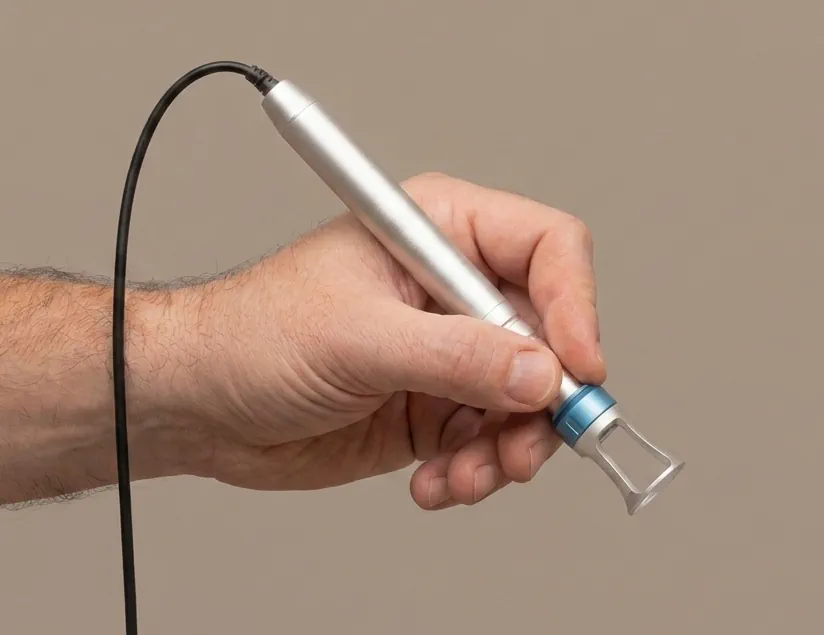
Class IV laser therapy uses focused light energy to penetrate deep tissue and support your body's natural healing process. No needles, no surgery, no downtime. Sessions run 5 to 15 minutes. It works on its own for many conditions, and it's frequently combined with Spinal Decompression Therapy when both address different parts of the same problem.
Laser therapy works through a process called photobiomodulation. The laser delivers light energy at specific wavelengths that your cells absorb. Inside the cell, that energy stimulates the mitochondria, the part of the cell responsible for producing energy. That increased cellular energy output supports tissue repair, reduces inflammation, and may interrupt pain signaling in nerves.
What separates Class IV from lower-powered Class III lasers is output power. Class IV devices output more than 500 milliwatts. That higher power level allows the light to penetrate deeper tissue and deliver more energy in each session. For conditions involving the spine, larger joints, or deep paraspinal muscles, that penetration depth matters.
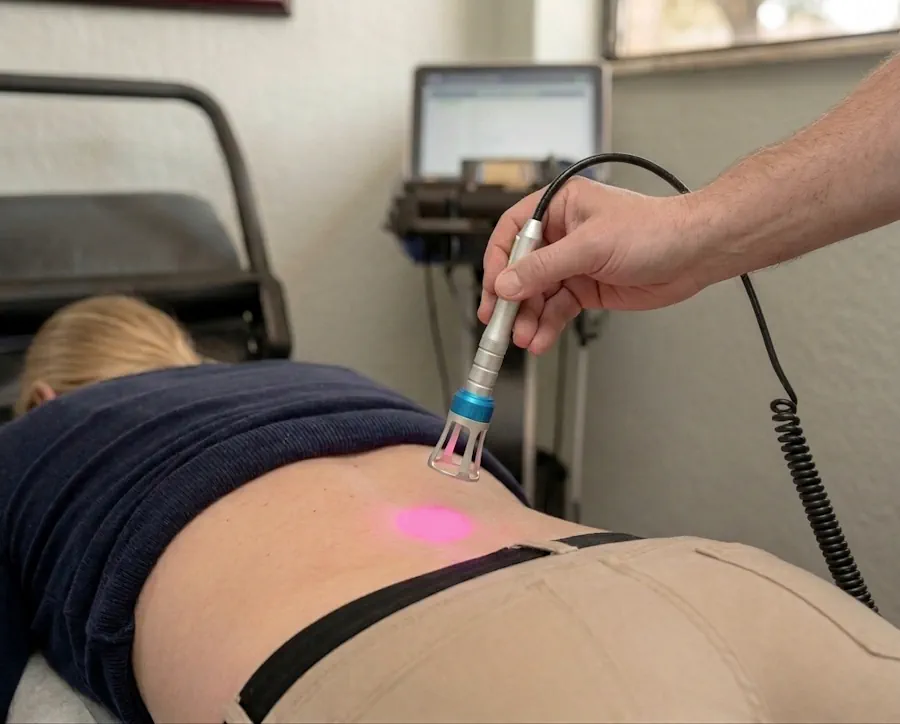
The treatment is non-thermal at safe operating levels, you feel warmth, not heat. The device is kept in motion over the treatment area throughout the session. There's no risk of burning when applied correctly.
When the laser is paired with Spinal Decompression Therapy, each tool has a clear job. Decompression is the mechanical piece, it changes pressure on the disc. The laser is the tissue piece, it works on the inflammation and nerve irritation that ride along with a disc problem. Pairing them treats the cause and the symptoms in the same course of care rather than in sequence. Individual results vary.
Laser therapy is used for a range of pain and tissue conditions. Here are the most common applications we see at OKC Pain Relief.
Laser therapy works on the inflammation and paraspinal muscle tightening that come with disc-related back pain. It is often run alongside decompression to treat the tissue while the disc is being addressed.
Learn MoreFor cervical disc and neck conditions, laser therapy targets the nerve irritation and chronic muscle tension that drive the pain, including neck-origin headaches. It is calibrated differently than for the lower back.
Learn MorePhotobiomodulation may help calm irritated nerve tissue and reduce the inflammatory response around compressed nerves. It's used as part of comprehensive sciatica care plans.
Learn MoreLaser therapy has been studied for osteoarthritis and inflammatory joint conditions. It may reduce joint pain and stiffness, particularly in the knees, hips, and shoulders.
Learn MoreMuscle strains, tendon and ligament injuries, contusions, and stalled soft tissue healing respond to laser at the cellular level. It speeds the repair phase, which is why athletes and active adults use it to get back sooner.
Learn MorePost-collision injuries involving cervical strain, muscle damage, and soft tissue inflammation often benefit from laser therapy as part of a broader recovery plan.
Learn MoreClass III therapeutic lasers are common in physical therapy and general chiropractic offices. They're legitimate tools. But the power difference between Class III and Class IV lasers is not trivial.
A Class III laser outputs 500 milliwatts or less. A Class IV laser typically outputs 1 to 15 watts or more. That means a Class IV device can deliver the same therapeutic dose in a fraction of the time, and it can reach deeper structures that a lower-powered laser can't penetrate effectively.
For conditions involving deep paraspinal muscles, larger joints, or nerves running near the spine, that penetration depth matters.
| Feature | Class III Laser | Class IV Laser |
|---|---|---|
| Power Output | ≤500 mW | >500 mW (often 1–15W+) |
| Tissue Penetration | Superficial to mid-depth | Deep tissue |
| Session Length | 15–30 min (typical) | 5–15 min (typical) |
| Dose Per Session | Lower | Higher |
| Best For | Surface and mid-depth conditions | Spine, large joints, deep tissue |
General comparison. Device specifications vary by manufacturer and model.
Your doctor reviews your condition, identifies the target tissue area, and determines the appropriate dosing protocol for your situation.
Both you and your doctor wear protective eyewear during the session. This is a standard safety step with all Class IV laser treatments.
The laser handpiece is moved in slow, deliberate passes over the treatment area. You'll feel gentle warmth. The session typically runs 5 to 15 minutes depending on the area and dosage protocol.
After the session, you leave. There's no recovery period, no restrictions, and no wound care. Most patients continue their day normally.
Laser therapy works cumulatively. A single session rarely produces lasting results. Your doctor recommends a series tailored to your condition and monitors your response throughout.
Most patients have never done laser therapy before their first visit. These answers cover what we hear most often.
View All FAQsNo. The most common sensation is mild, pleasant warmth. The device stays in motion so heat doesn't accumulate. If you feel anything beyond comfortable warmth, tell your doctor immediately so the protocol can be adjusted.
Some patients notice reduced pain and improved mobility within a few sessions. For chronic conditions, meaningful improvement typically builds over several weeks. Acute injuries often respond faster than long-standing problems.
Yes. Laser pairs with either one, and we do this regularly. Decompression addresses mechanical disc pressure while laser addresses the inflammation and nerve irritation around it. Shockwave drives tendon and soft tissue repair while laser works on the inflammatory response in the same area. Which pairing you get depends on your diagnosis. Individual results vary.
Class IV laser therapy has a strong safety record when administered by trained providers using appropriate protocols. The primary precautions are protecting the eyes (handled with required eyewear) and avoiding direct application over active cancer or areas with suspected malignancy. Your doctor reviews your health history before proceeding.
Laser therapy is generally contraindicated for patients with active or suspected cancer in the treatment area, patients on photosensitizing medications, and application over the eyes or thyroid gland. Pregnancy is a relative contraindication depending on the treatment area. Your doctor reviews your full health history at your consultation.
The evidence on laser therapy for back pain is mixed, and it is worth being straight about that. A 2023 systematic review with meta-analysis found high-intensity laser therapy produced statistically significant reductions in low back pain intensity and disability compared to control. A separate large review of photobiomodulation across lower-power devices found the effect on pain and disability clinically unimportant for non-specific low back pain, with the overall certainty of evidence rated low. We use high-intensity Class IV laser, present it as a reasonable option rather than a guaranteed result, and recommend it only after evaluation. These references are provided for transparency and are not a substitute for individual medical assessment.
Abdildin Y, et al. High-intensity laser therapy in low back pain management: a systematic review with meta-analysis. Lasers in Medical Science, 2023. PubMed 37493840
Tomazoni SS, et al. Photobiomodulation therapy does not decrease pain and disability in people with non-specific low back pain: a systematic review. Journal of Physiotherapy, 2020. PubMed 32680739
A free consultation lets one of our doctors review your condition and give you a clear picture of what to expect from laser therapy, alone or combined with spinal decompression.
Individual results vary. Treatment is recommended only after clinical evaluation and a determination of candidacy.