Regenerative Treatment

Shockwave Therapy in Edmond, OK

A non-invasive, certified treatment for chronic pain, tendon injuries, and stubborn soft-tissue conditions that haven't responded to rest, injections, or standard care. No surgery. No downtime. Dedicated appointments with certified providers.

The Treatment

How Radial Shockwave Therapy Works

Shockwave therapy delivers high-energy acoustic pressure waves into injured or chronically painful soft tissue. The waves are generated by a handheld applicator pressed against the skin and directed at the exact location of the problem. No needles. No incisions. You stay fully clothed for most applications.

The mechanism is regenerative. Damaged tendons, muscles, and connective tissue often reach a state where they stop actively healing. The biological repair process stalls. Acoustic pressure waves disrupt that stalled state by stimulating blood flow, triggering the release of growth factors, and prompting the tissue to restart the repair cycle. Over a series of sessions, many patients see reductions in pain and improved function in areas that had plateaued under other care.

The device used here is a radial shockwave system. Radial shockwave disperses energy outward from the applicator tip and is well-suited for tendons, muscle attachments, and the kind of broad, chronic soft-tissue pain most patients come in with. Treatment sessions are brief, typically 10 to 20 minutes for the application itself, with the full appointment running longer to include assessment and documentation.

Shockwave works well alongside the clinic's other therapies. A patient dealing with knee pain from a tendon condition and accompanying inflammation often benefits from pairing shockwave with Class IV Laser Therapy, which works on the inflammatory component at a cellular level. For patients with both disc-related and soft-tissue pain, all three services can be part of a single coordinated plan. Individual results vary.
Important: Shockwave therapy is not a universal pain treatment. Candidacy depends on your diagnosis, health history, and the specific tissue being treated. A clinical evaluation determines whether it's appropriate for you.
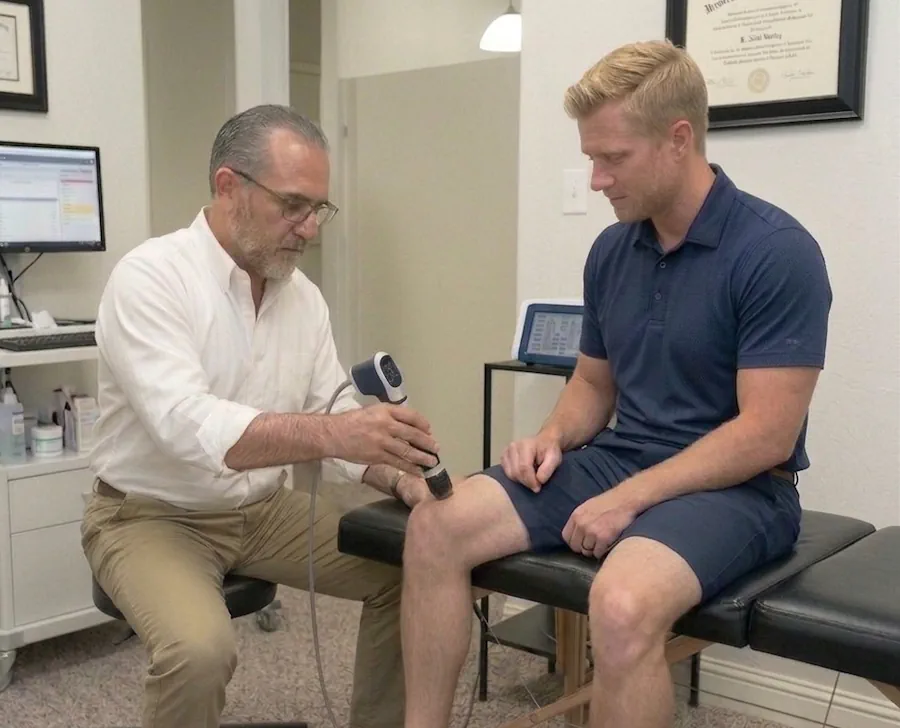
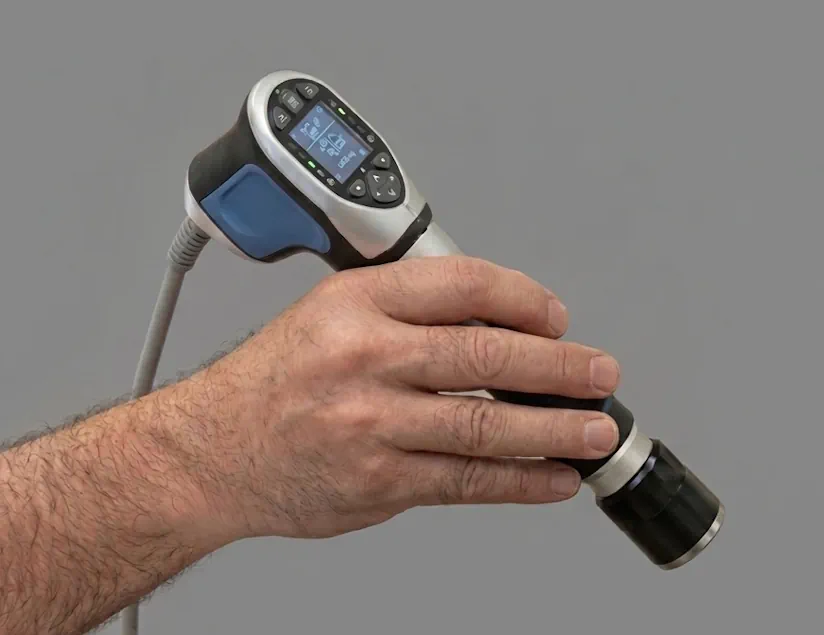
Shockwave therapy applied to patient knee at OKC Pain Relief in Edmond, Oklahoma Shockwave therapy device applicator at OKC Pain Relief in Edmond, Oklahoma
Who It May Help

Conditions Treated with Shockwave Therapy at OKC Pain Relief

Shockwave is most effective for chronic soft-tissue and tendon conditions, especially those that have stalled under standard care. These are the diagnoses we treat most often.

Plantar Fasciitis & Heel Pain

One of the most studied uses for shockwave therapy. Chronic plantar fasciitis that hasn't resolved with rest, stretching, or orthotics often responds well to a targeted shockwave course.

Learn More

Knee Pain & Patellar Tendinopathy

Jumper's knee, patellar tendinopathy, and general chronic knee pain from tendon stress are primary targets. Shockwave addresses the tendon tissue directly rather than masking the pain.

Learn More

IT Band Syndrome

Lateral knee and hip pain from iliotibial band tightness and irritation responds to shockwave when the tissue around the attachment points is chronically inflamed or thickened.

Learn More

Shoulder Pain & Rotator Cuff Conditions

Chronic shoulder pain, rotator cuff tendinopathy, and calcific deposits in the shoulder are all within shockwave's range. For some patients it's a viable step before considering more invasive intervention.

Learn More

Tennis Elbow & Golfer's Elbow

Lateral and medial epicondylitis are tendon overuse injuries that often linger for months. Shockwave stimulates the repair process in the damaged tendon attachment in a way that rest alone typically cannot.

Tennis Elbow Golfer's Elbow

Low Back & Hip Pain

Chronic low back pain with a soft-tissue or muscle attachment component, including deep hip and gluteal pain, responds differently than disc-related back pain. Shockwave targets the tissue; spinal decompression addresses the disc. Sometimes both are relevant.

Learn More

Achilles Tendinopathy & Shin Splints

Achilles tendon degeneration and medial tibial stress syndrome (shin splints) are common in active patients and athletes. Shockwave can be part of returning to activity without resorting to extended rest or injection cycles.

Achilles Shin Splints

Sciatica & Peripheral Neuropathy

When nerve pain has a soft-tissue compression or trigger-point component, shockwave may address the muscular source of that irritation. It's not a replacement for decompression therapy in disc-related sciatica, but for nerve-related pain with a tissue component, it's worth evaluating.

Sciatica Neuropathy

Morton's Neuroma & Foot Pain

Nerve compression between the toes and chronic foot pain from soft-tissue origin are treatable areas for shockwave. Results depend on the specific structure involved and how long the condition has been present.

Learn More

Frozen Shoulder

Adhesive capsulitis causes the shoulder capsule to tighten and contract progressively, limiting motion in every direction. Shockwave therapy targets the inflamed capsule tissue to support recovery without surgery or manipulation under anesthesia.

Learn More
Candidacy note: Shockwave therapy is not appropriate for everyone. Contraindications include pregnancy, active infection at the treatment site, blood clotting disorders, malignancy in the treatment area, and implanted electronic devices near the site. Your evaluation will determine whether you qualify.
The Patient Experience

What to Expect at Your Shockwave Therapy Sessions

Shockwave gets its name from the technology, not from the experience. Here's what the actual process looks like from your first call through the end of your treatment course.

1

Free Consultation and Evaluation

One of our certified providers reviews your history, symptoms, and any imaging or prior treatment records you have. We identify whether shockwave is the right fit, and if so, exactly which structures we'd be targeting.

2

Your Treatment Plan

You receive a written plan with the number of sessions recommended, the frequency, and the pricing structure. Shockwave is cash-pay and not covered by most insurance plans. We offer per-session, package, and bundled pricing. No surprises.

3

Your First Shockwave Session

The provider locates the treatment area precisely, applies gel to the skin, and begins with the applicator at a lower intensity. Most patients feel a rhythmic tapping or pulse. The intensity increases gradually to the therapeutic level. Sessions typically run 10 to 20 minutes for the shockwave application itself.

4

Between Sessions and Mild Aftereffects

Mild soreness or tenderness at the treated site is normal for 24 to 48 hours. It's a sign the tissue is responding. Avoid intense activity targeting that area for the first day or two, then return to normal routine. Most patients schedule sessions about a week apart to allow the repair response to work between visits.

5

Progress Check and End of Care

We assess your progress at each session and adjust the protocol if needed. Once your course is complete, we discuss what ongoing maintenance, if any, makes sense and whether other therapies like Class IV Laser Therapy would support your long-term outcomes.

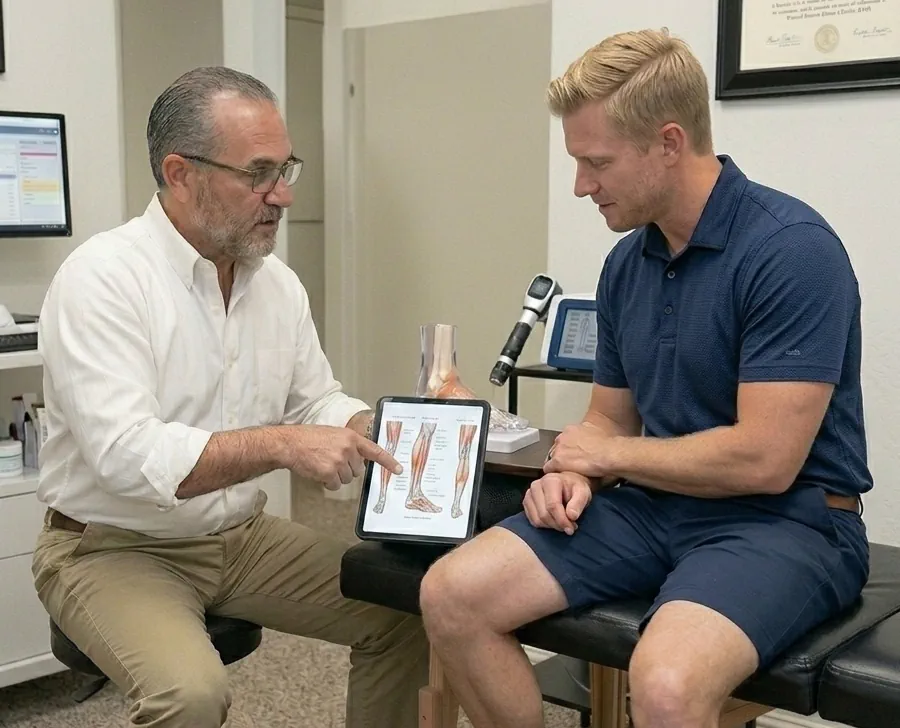
Provider consultation before shockwave therapy at OKC Pain Relief in Edmond, Oklahoma

Quick Facts

Session LengthDedicated appointment type
Typical Course3–6 sessions
FrequencyApprox. once per week
TechnologyRadial shockwave device
ProvidersCertified
DowntimeNone (most patients)
InsuranceNot typically covered
PricingPer session, packages, bundles, financing available
Works withLaser Therapy, Spinal Decompression

Individual results vary. Treatment plans are personalized based on clinical evaluation.

Putting It in Context

Shockwave Therapy Compared to Other Treatment Options

This is a straightforward look at where shockwave fits, not a claim that it replaces other care. Some patients need more than one approach.

Approach Invasive? Targets Tissue Directly? Typical Downtime? Notes
Radial Shockwave Therapy No Yes None (most patients) Multiple sessions required; not covered by most insurance
Corticosteroid Injections Minimally Indirectly Short Reduces inflammation but does not repair the tissue
Surgery Yes Yes Weeks to months May be necessary when conservative options are exhausted
Physical Therapy / Exercise No Indirectly None Builds strength and flexibility; doesn't directly stimulate repair
Class IV Laser Therapy No Yes (cellular) None Works on inflammation and repair; often combined with shockwave
Rest and NSAIDs No No None Manages symptoms; does not reverse tendon degeneration

This table is general and educational. It is not a substitute for professional medical evaluation. The right treatment depends on your specific diagnosis and health history.

Frequently Asked Questions

Your Questions About Shockwave Therapy

These are the questions we hear most before a first session. If yours isn't here, call us or book a free consultation and we'll answer it directly.

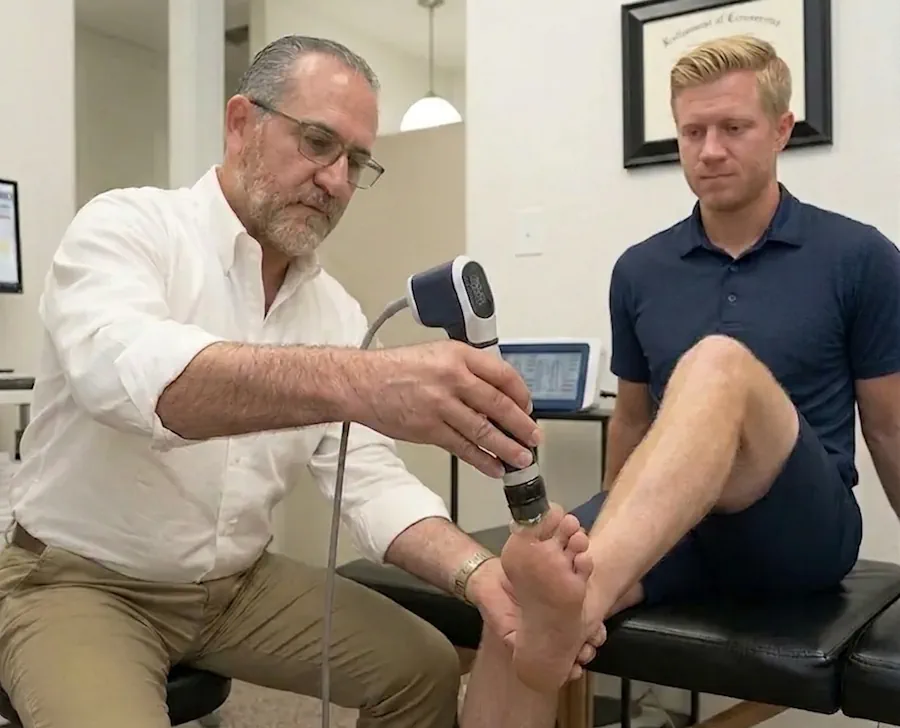
Doctor applying shockwave therapy to patient foot for plantar fasciitis treatment at OKC Pain Relief in Edmond, Oklahoma

Most patients describe a rhythmic tapping or pulsing sensation at the treatment site. It's not painless, especially over a tender area, but most people tolerate it well. The intensity is adjustable, and your provider will dial it to a level that's firm but manageable. Mild soreness for 24 to 48 hours after the session is normal.

Most conditions respond to a course of 3 to 6 sessions, typically spaced a week apart. Chronic or complex cases sometimes require more. Your provider sets a specific treatment plan after the consultation and evaluates your progress as you go. If the therapy isn't moving in the right direction, we'll tell you.

No. There's no recovery period. Most patients return to normal activity the same day. We typically ask that you avoid strenuous exercise targeting the treated area for 24 to 48 hours, but routine daily activities are fine.

Shockwave therapy is not appropriate for patients who are pregnant, have a blood clotting disorder or are on anticoagulant medication, have an active infection or open wound at the treatment site, have malignancy in or near the area to be treated, or have a pacemaker or implanted electronic device in the vicinity. Your doctor reviews your health history before any treatment.

Neither. Radial shockwave therapy uses high-energy acoustic pressure waves, not electrical current and not diagnostic ultrasound. The waves are generated mechanically and delivered through a handheld applicator pressed against the skin. No needles, no incisions, no electrical stimulation.

Shockwave therapy is not covered by most insurance plans. It is offered here on a cash-pay basis. We provide per-session pricing, package options, bundled visit pricing, and financing options. Call us or ask at your consultation and we'll go over the specifics for your situation.

Yes. Many patients at this clinic use more than one treatment as part of a coordinated care plan. Shockwave targets tendon, muscle, and connective tissue. Spinal decompression addresses disc and nerve pressure. Class IV Laser Therapy works on inflammation and tissue repair at a cellular level. When the conditions overlap, combining them often produces better outcomes than any one treatment alone. Individual results vary.

Some patients notice improvement after the second or third session. For long-standing tendon conditions, meaningful change typically builds over several weeks. The process involves stimulating the body's own healing response, which takes time. We set realistic expectations at the start so you know what to watch for and when to reassess.

For Those Who Want the Source

Clinical References

The clinical evidence for radial shockwave therapy is strongest for plantar fasciitis, calcific shoulder tendinopathy, lateral epicondylitis (tennis elbow), patellar tendinopathy, and Achilles tendinopathy. A 2022 review of best practices in the Journal of Clinical Medicine describes shockwave as a first-line or second-line treatment option for several tendinopathies and notes a favorable safety profile when properly administered. Earlier systematic reviews and studies support its use for calcific conditions in particular, where the mechanical effect on calcium deposits is well-documented. Evidence is more mixed for other conditions, and results across individuals vary. We present shockwave as a reasonable option to consider after evaluation, not a guaranteed outcome. These references are for transparency and do not replace individual medical assessment.

Best practices for extracorporeal shockwave therapy in musculoskeletal medicine. Journal of Clinical Medicine, 2022. PMC9321712

Extracorporeal shock wave therapy in musculoskeletal disorders. Journal of Orthopaedic Surgery and Research, 2012. PMC3342062

Shockwave treatment: a new wave for musculoskeletal care. Mayo Clinic. Mayo Clinic professional overview

Next Step

Find Out If Shockwave Therapy Is Right for You

A free consultation with one of our certified providers is the right starting point. We'll review your history, answer your questions, and give you an honest answer about whether shockwave therapy fits your situation.

Individual results vary. Shockwave therapy is recommended only after clinical evaluation and determination of candidacy. This page is informational and does not constitute medical advice.